Is a service horse right for me?
Deciding to get a service animal is a huge commitment that should not be taken lightly. It’s important to understand just how much work goes into having a service animal, if they are the best match for your lifestyle, if they are the best way to help you with your disabilities, how much they will cost, the best way to go about getting one, and the issues you will face when working with one.
There are no shortage of excellent resources and programs out there for people considering a service dog. But what about a service horse?
Just how different are they?
This article will help to answer those questions.
What can service horses do?
Horses have worked alongside humans for millennia, taking on countless different roles. The number of things a service horse can do still surprises a lot of people, though. Here is a list of service horse tasks that can be trained, but it’s far from complete.
Guide a blind handler in a straight line down sidewalks, rural roads with no sidewalks, hallways, and aisleways.
Maneuver a blind handler around obstacles in their path, such as tree roots, tree branches, mailboxes, signs, etc.
Stop at terrain changes to prevent a blind handler from tripping such as at up curbs, down curbs, steps, and tripping hazards.
Locate items for a blind handler when asked such as doors, counters, steps, trash cans, empty chairs, etc.
Retrieve dropped objects.
Retrieve specific objects, such as by name or when pointed to.
Push buttons to open doors.
Turn lights on and off.
Brace against a heavy door to hold it open while the handler passes through.
Pull a wheelchair.
Provide forward momentum when walking.
Provide a brace and or forward momentum to help someone to rise from the floor or a seated position.
Brace so that the handler can use the horse to help themselves balance.
Brace to help catch a person who loses their balance to prevent them from falling.
Help a person balance while maneuvering up or down stairs.
Carry medication and medical items for a handler.
Remind a handler to take their medication.
Alert a handler to oncoming medical events, such as changes in blood sugar and migraines.
Maneuver a handler experiencing a medical crisis to a quiet spot.
Help a handler experiencing a medical crisis to locate a place to sit.
When taking into account a person’s specific circumstances and what would be helpful for them, the list of things you can teach a service horse becomes nearly endless.
How practical are service horses?
When a lot of people hear the term service horse for the first time, it conjures up an image of someone trying to fit a 1200 pound Thoroughbred in a restaurant.
Miniature horses aren’t nearly that big, but they definitely aren’t as convenient as a 60 pound Labrador.
Legally, service horses must be 34 inches tall or shorter. However, 34 inches would be an impractical size in a number of situations and is probably unnecessarily large. A 32 inch horse is the largest size that we will train, but even a 30 inch horse is going to work for the majority of people, even if doing heavy mobility tasks.

Image description: Flirty, a gray mini, and Stanley, a black Labrador, standing together in TJ Maxx. Flirty is on the left, wearing her black halter, rainbow leash, black harness with rainbow trim, black vest with rainbow text, black blanket, and hoof boots. She is facing the camera and has one ear forward while the other listens behind her to someone off camera who was moving around. Stanley is standing on the right, wearing his orange Halloween bandana and guide harness. His features are a bit hard to make out, because he is imitating a black void. Teagan’s lower body is visible, standing between the two animals. Flirty is only about 3 inches taller than Stanley, but with more substantial body mass. There are dog beds behind them, piled up on a shelf.
A 30 inch horse is fairly comparable to a manual wheelchair. They fit in most spaces, but sometimes it can be pretty tight. This is why using the smallest horses possible is always desirable.
Horses cannot fold themselves up the way dogs can. They cannot go under a bus seat or restaurant table. Having them stand next to a seat or table will work fine in the majority of situations but is something that you have to be cognizant of.
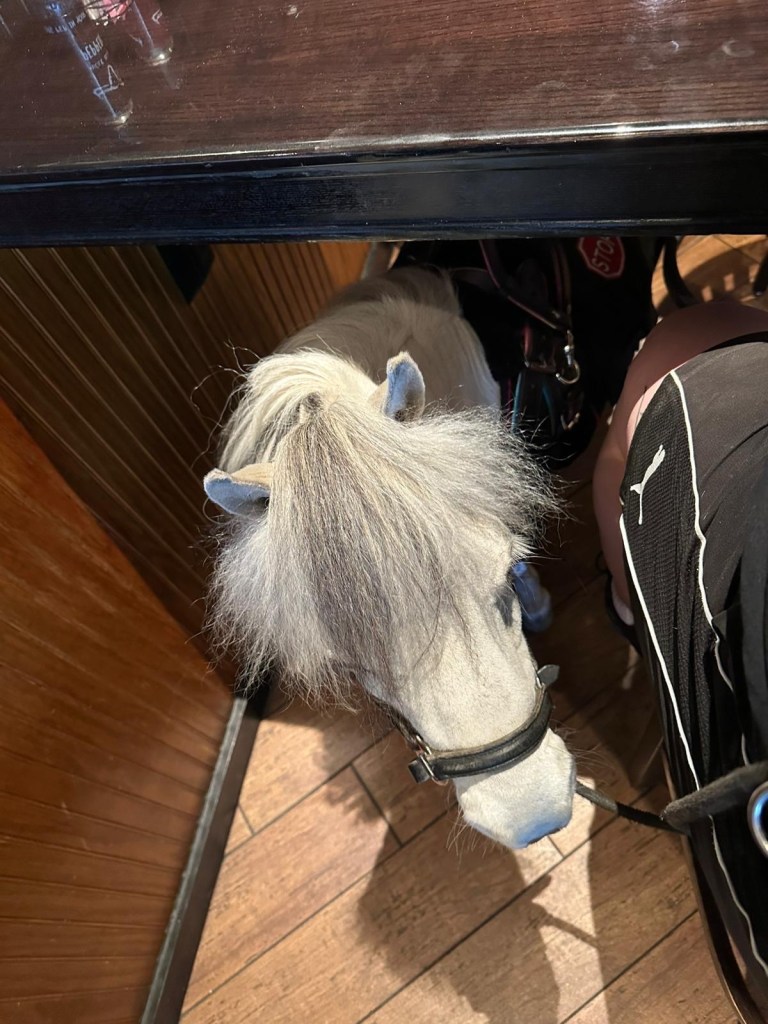
Image description: A grey mini horse in a restaurant. She is standing under a high top table beside her handler, watching and waiting for signs that her help is needed.
Horses are also harder to transport. They can’t simply hop into a car and go. It is common for service horse handlers to have a van with one backseat removed where the horse can stand.
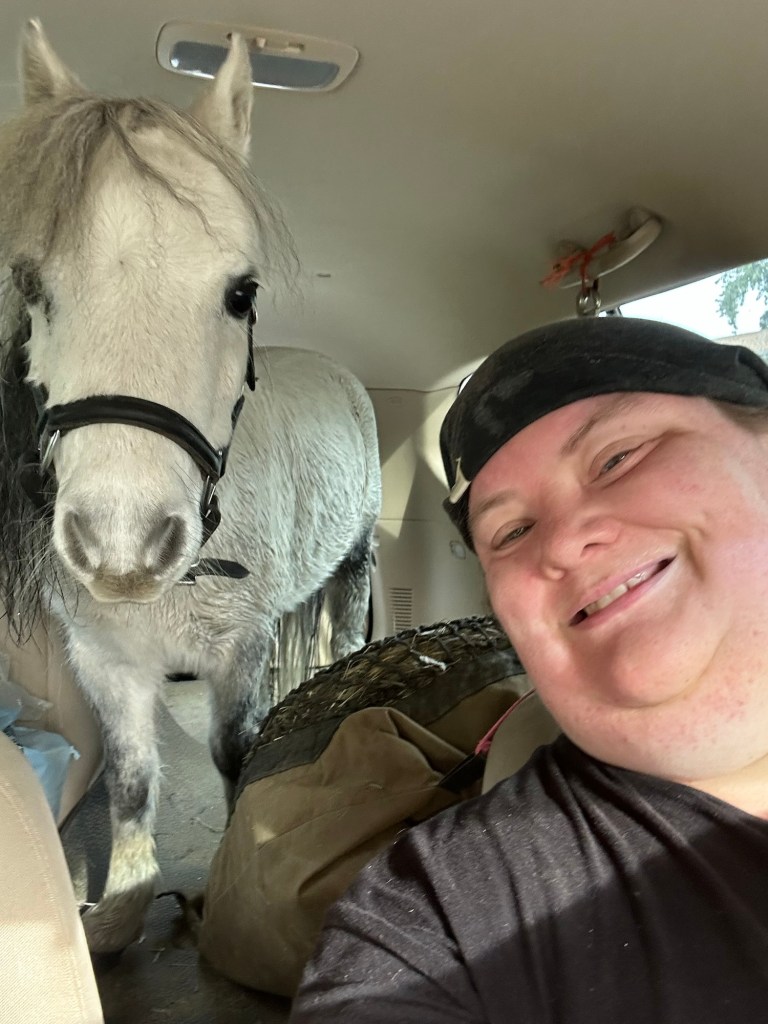
Image description: A selfie with Abrea and Flirty in the car. Abrea is sitting in the driver’s seat, leaning in to be part of the picture. She is smiling and wearing a black beanie. Flirty, in the back of the car behind her, is looking on with interest, wearing just her black halter. There is a hay pillow stuffed with hay behind the driver’s seat.
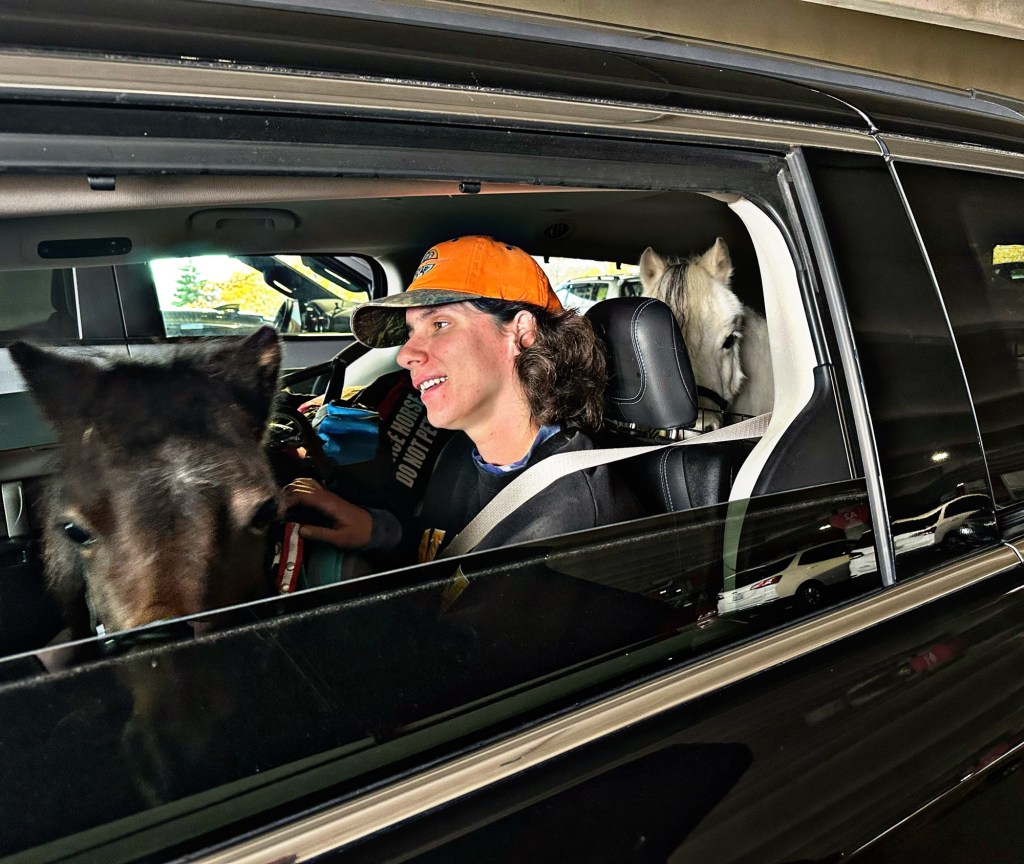
Image description: Cali, Teagan, and Flirty in a van. The picture is taken from outside the open window, looking in. Cali, a bay mini, stands in the middle row beside Teagan, only her eyes, forehead, and ears visible above the window. Teagan is smiling and has one hand resting on Cali’s guide harness. Peeking out from behind Teagan’s seat is Flirty’s little white face, which is partially obscured by the headrest.
Food is also an important consideration. A horse should never go more than four hours without eating. After four hours without anything in their stomach, their body actually goes into starvation mode. They are more likely to get ulcers, are stressed, and can develop anxiety around food due to worrying about having enough of it.
A horse’s need to trickle feed actually lends itself to training them, however. They are an inherently food motivated species, and the majority of horses can be trained with simple hay pellets. If you are only going to be out for an hour or two, the occasional larger handful of pellets (which still isn’t a lot because the horses are so small) should be plenty. If you are going on a longer excursion, though, you’ll need to be sure to bring enough food along.
There is, of course, grooming as well. Not only is it important that your horse be cleanly when going into public spaces, but any time you are out in public you are representing the service horse community as a whole, and it’s important to always put your best foot forward. Since horses live outdoors, grooming them before going on an excursion is important. They don’t need to be ready to go compete in a show, but they do need to be brushed down to remove dust, dirt, and loose hair and have their feet thoroughly cleaned.
There is also the matter of clipping. Miniature horses, having been developed largely from Shetland Ponies, have a tendency to hold onto their winter coats far too late in the year. To keep them from overheating, they often need to be clipped in the spring. And, if they are going to spend any amount of time indoors during the winter, they will need some or all of their winter coat clipped. Their fluffy winter coats are remarkably effective at keeping horses warm.
Once a horse has been clipped, you are responsible for their temperature regulation. Without that winter coat, they get cold very easily when outdoors.
Horses have a higher body temperature than humans, more mass, a digestive system that generates a ton of heat, and a coat that is remarkably skilled at trapping heat. This is why the majority of horses handle extremely cold temperatures without issues. In fact, their coats are so efficient at trapping heat that when it snows, they will actually get a buildup of their own personal snowbank along their backs, because so little body heat escapes it does not melt. Obviously, when you’re that good at staying warm, it probably doesn’t feel too nice to go inside a building that is 74°.
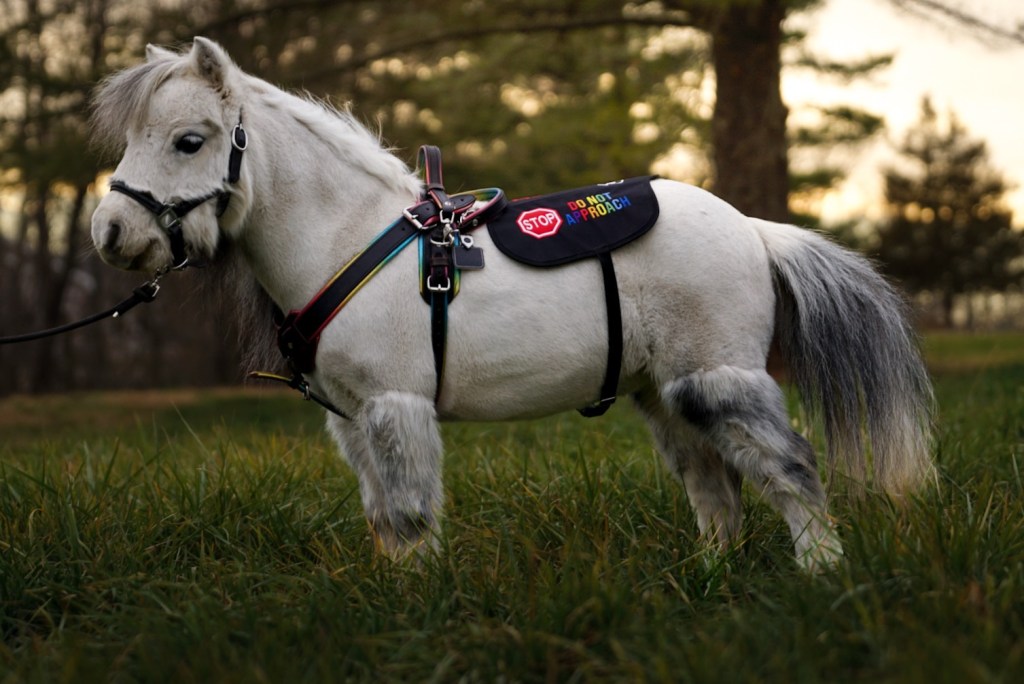
Flirty, a gray mini, standing in deep, green grass. It’s very evident that she has had a body clip, but her face and legs were left long. Her body and neck are clipped fairly short, but her face is super fuzzy and her legs have such long, thick hair that it looks like she is wearing stockings. You can also see a line of demarcation where her neck was clipped, but then the clip job ends to leave her mane long. Flirty is wearing her black halter and leash, black harness with rainbow trim, and black vest with rainbow text. The evening sun glows gently through the trees in the background.
The amount of time your horse spends indoors, and how warm they seem to get when they do so will dictate how much of their coat you need to clip. You will need to have several blankets of different weights on hand and be able to change them when the temperature fluctuates to keep your clipped pony toasty outdoors.
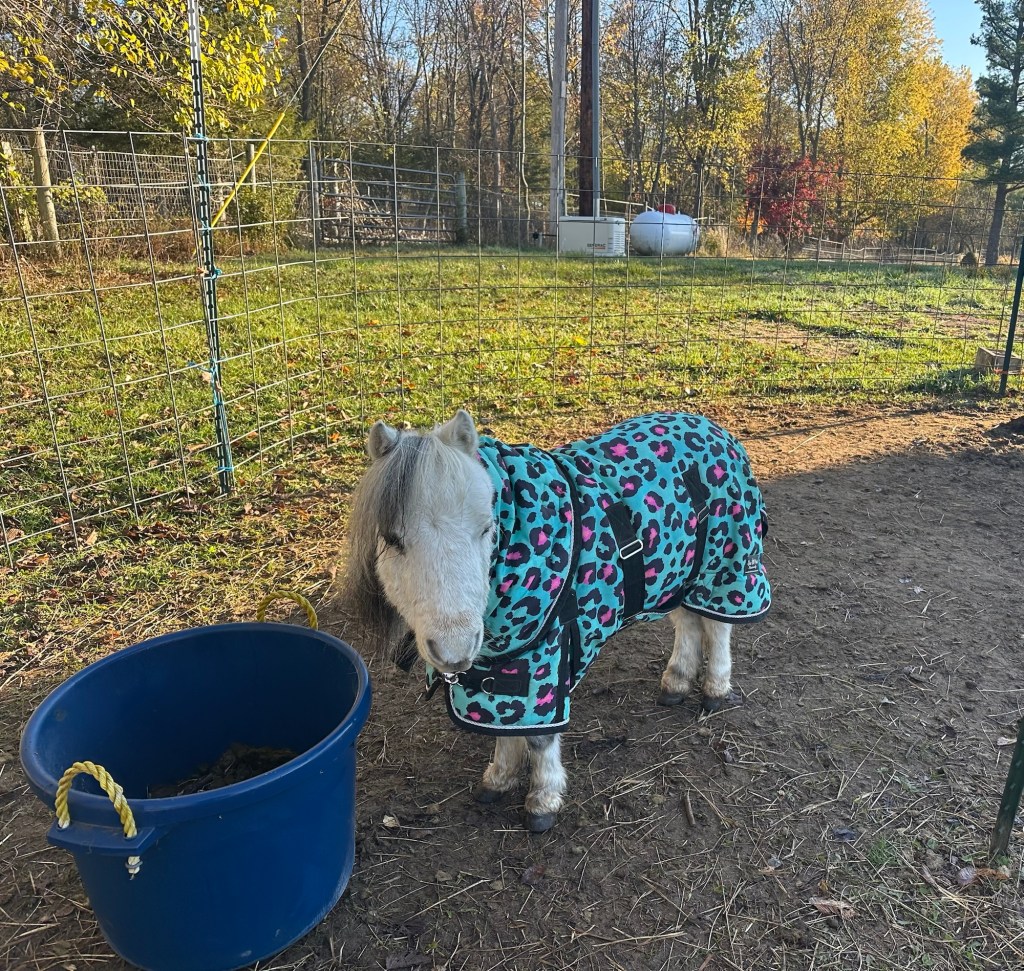
Image description: Flirty stands outdoors in a paddock near a blue muck bucket with yellow rope handles. She wears a blanket with a neck cover that is bright teal with cheetah print.
I know that sounds like a lot, and it definitely is. Service horses are absolutely not for everyone, just as service dogs are not for everyone. Even though, legally, they are essentially classified as medical equipment, they are living, breathing creatures. They aren’t a medical device you can grab when you need and put away when you don’t. It’s very important to truly think through all of those practicalities when considering if a service horse is right for you.
Would a horse or dog be better?
What is it that drew you to service horses overservice dogs?
Would the tasks you need help with be more appropriate for a horse or a dog?
Practically speaking, a dog is probably a better choice in the majority of situations. Unless you are unable to have a dog, it’s important to really examine why you are considering picking a horse instead.
Attention
One of the biggest drawbacks to having a service horse is the amount of attention, and even pushback, you will receive. Yes, they are legal, but a majority of people still don’t know about them. They are still very few and far between. You will get a ton of attention wherever you go. People will ask you invasive questions and take photos without asking. No more quick five minute trips to the grocery store; expect to get treated like the novelty it is.
One way some handlers choose to deal with this is to keep cards on hand with information about service horses that they can hand to people who are curious if they don’t have or want to spend the time talking to them.
Access Refusals
Expect to run into exponentially more access refusals with a service horse than you would with a service dog. You are going to have to do a lot of explaining to business owners about service animal laws, and it’s important to know them well.
Horses Are Not Just Big Dogs
Yes, these incredibly tiny horses are smaller than the biggest breeds of dog, but they are a completely different species. Some of these differences are good for service work, others are not.
The biggest thing to keep in mind is that horses have not been domesticated nearly as long as dogs. They do not find the companionship of people intrinsically reinforcing the way dogs do.
As I write this, my dog is curled up next to me on the couch and partially draped over my lap. My mere companionship brings him comfort and happiness.
When I walk out to the field, there is a good chance I will get mugged by a group of ponies. They want to know if I’m bringing them more food, have something interesting for them, if I will scratch their itchy spots, or if we get to play fun games. Horses absolutely love clicker training, and are happy to work for us because to them, it’s just a fun game. However, without any of these things to keep them occupied, they will always drift off and go back to doing horsey stuff, some sooner than others, but they all do.
All of this is to say that horses need to be allowed to be horses, and we cannot ask them to take the place of dogs.
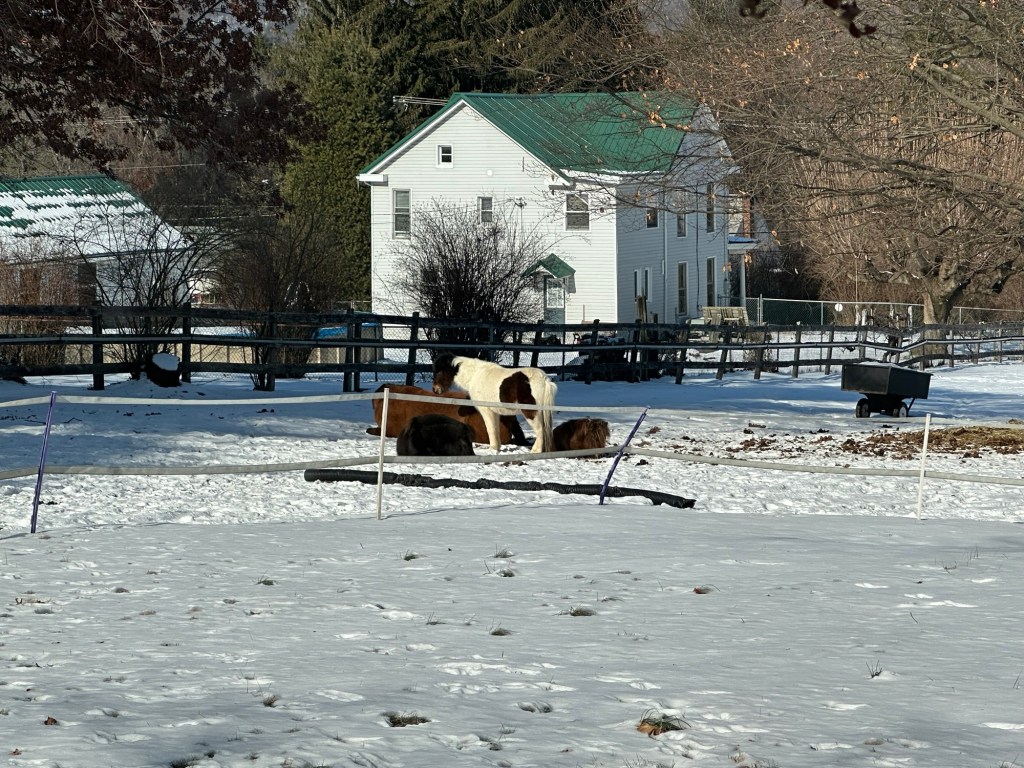
Image description: A bay and white pinto miniature horse stands in a snowy yard, a tree in the background. In a triangular formation around him, two other miniature horses and one full-size horse all lay down, sleeping.
Don’t take this to mean horses aren’t happy to work for us, though. Because we train with positive reinforcement, our horses absolutely love their jobs. If we pull one aside to work with them, everyone else will gather at the fence, hoping to be picked next. We intentionally pick people oriented horses for our training program, and clicker training has a tendency to turn horses into much more dog like creatures than traditionally trained horses. They are still inherently different from dogs, though, and it’s important to understand a horse’s nature to have reasonable expectations of what the relationship will be like, know what is normal and what is concerning, and how best to keep them happy.
Letting Horses Be Horses
Horses cannot replace dogs. They can do most things that Dogs can, and some that they can’t, but there are some tasks that dogs are more suited to.
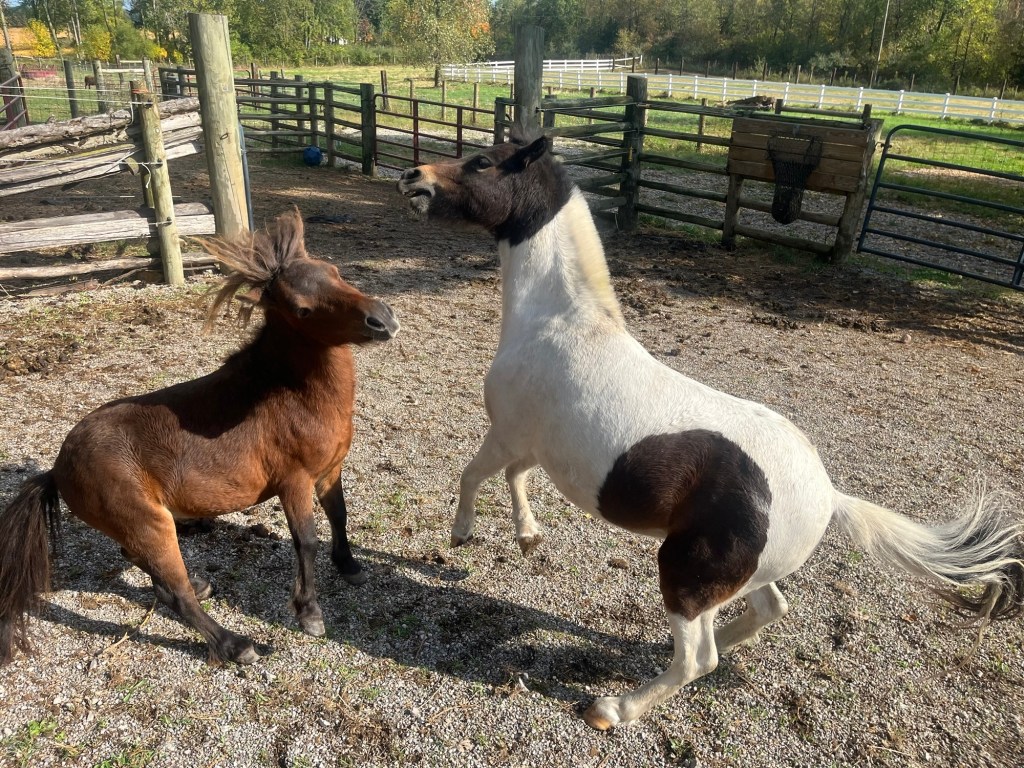
Image description: Two miniature horses stand broadside to the camera, facing one another, each rearing up on their hind legs. On the left is a tiny bay with a huge mane and forelock that flow luxuriously with his movement. On the right is a much taller, very petite bay and white pinto.
What tasks are better for service dogs?
Tasks that require the service animal to be around the person 24/7, always paying some amount of attention are not appropriate to ask of a horse. These sort of tasks are things like hearing assistance, seizure alert, diabetic alert, and monitoring and providing assistance to a severely physically impaired handler. That’s not to say that a horse can’t do these things, but a horse cannot reasonably stay with a person at all times waiting for a cue. It is, of course, more than okay to teach a horse to do things like alert to changes in blood sugar, but the horse cannot stay indoors, follow you around, and always pay attention to this the way a dog can. If all you need is to be alerted to changes in blood sugar, a dog would be a much better choice. If you need help with other things and would also like a horse that can alert to changes in blood sugar, that is more than okay. Just understand that your horse will not be able to provide this service at all times.
What tasks are service horses better for?
The biggest thing that horses are more suitable for than dogs is heavy mobility work. They are extremely strong, sturdy animals that can pull and carry a lot of weight. Relative to body size, the Shetland pony is actually the strongest breed of horse in the world.
A dog’s spine is very different from that of a horse, and it is not appropriate to lean your weight on a dog, as it is very detrimental to their health over time. If you are especially tall, especially heavy, or would like to be able to lean on your service animal for support, a horse very well might be perfect for your situation.
Besides these two scenarios, dogs and horses have fairly comparable abilities, and which one would be better depends entirely on a person’s situation and preferences. 
Do I have to have horse experience to get a service horse?
No. The CALI Corp understands that access to horses can be extremely limited to nonexistent for many people. Excluding people who do not have extensive horse experience would be completely unfair.
That being said, you are going to have a lot to learn. It is imperative to understand horse body language and communication, feeding, management, and possible health complications.
There is an endless amount to learn about horses, but there are also countless resources out there to help you do just that.
We are here to help students become knowledgeable horse owners. We can point you to many excellent resources, and are continuing to put together our own.
What is it like to care for a service horse?
Owning horses is a lifestyle. There are countless people who find them to be more than worth it, but there is a lot that goes into it.
Hoofcare
Horses’ hooves need to be trimmed on a regular basis. It is common to see a recommendation of between six to eight weeks between trims, but these numbers are somewhat outdated. How often your horse needs trimmed varies based on your environment, but four to five weeks between trims is ideal for most. A good rule of thumb is that if you look at your horse’s feet and think “they could use a trim” because they look too long, you need to shorten your trim cycle. This is something that does require a more experienced eye and someone who is new to horses may not pick up on this. Your farrier can help you determine an appropriate hoof maintenance schedule and you will learn what their feet should look like over time.
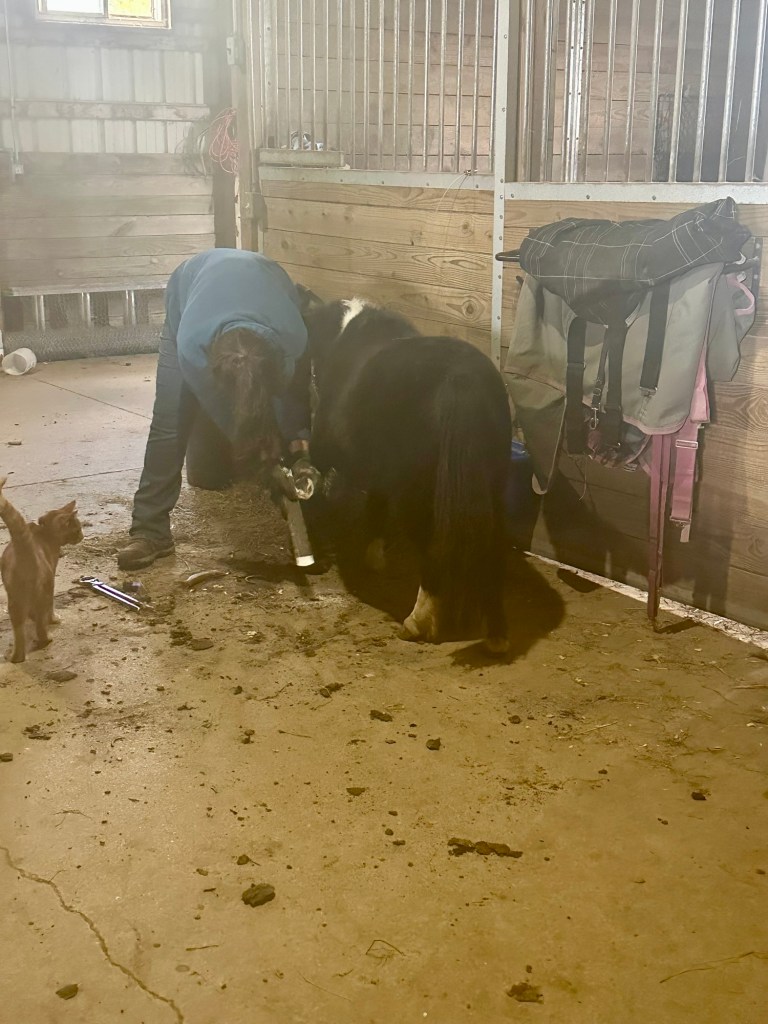
Image description: The farrier leans over beside Lucy with a rasp in her hand to work on her left front hoof. A pair of hoof nippers lay on the floor within reach, and there are bits of hoof clippings from other horses scattered around the floor. Lucy, a black and white mini, is facing away from the camera, so you are just seeing her butt and her back. An orange cat is walking by on the far left side of the picture. Behind Lucy, some blankets hang on the blanket bar on the stall she is standing beside.
Grass
You might be thinking that you have a quarter acre backyard that is fenced in and grassy. Perfect! Your horse can eat that. Unfortunately, it is not that simple.
Just because it’s grass doesn’t mean that horses can or should eat it. There are many invasive species, such as Japanese stilt grass, that horses will not touch. In the United States, grass has been heavily cultivated for raising cattle. Cattle grass, such as rye, is extremely high in sugar and very unhealthy for horses.
Evaluating and managing your pasture is crucial. An excellent resource for this is your state university’s extension office.
One of the most important aspects of pasture management is not overgrazing. Ideally, grass should be a minimum of six inches tall before horses are turned out on it and allowed to graze. When the grass is three inches or shorter, that area should be rested.
The reason for this is that short grass is stressed grass, and stressed grass is sugary. Miniature horses are extremely prone to health complications from sugar and minimizing it in their diet is critical. CALI Corp will help any individuals with whom we place service horses manage their area by providing advice. It’s a lot to take in and takes time to understand.
There are many different pasture management systems out there. Rotational grazing, strip grazing, track systems, and limited turnout are just some of them. You need to have a good enough understanding of pasture management to keep yours healthy, so your horse can both graze it and stay healthy for a long time to come.
Hay
Hay is indeed for horses. Long stem forage should be the staple of any horse’s diet. Finding a hay supplier who can give you good quality hay is important. How much you will use will depend on the time of year and whether or not your horse gets any pasture.
Hay can be tested to look at what nutrients it contains and how much sugar and starch it has. In a perfect world, every miniature horse owner would have easy access to low NSC (nonstructural carbohydrate) hay.
Horses should have access to food nearly 24/7. Remember, if they go more than four hours without eating, it is severely detrimental to their health.
Different varieties of slow feeders, such as nets, are an excellent way to slow your horse down, so they are kept busy for longer and reduce hay waste.
Ration Balancers
In popular culture, there is a strong correlation between horses and oats, and it used to be the norm to feed all horses grain on a daily basis. However, our knowledge of equine nutrition has advanced greatly, and we now know that grain is actually quite detrimental to a horse’s intestinal health.
The type of feeds that people commonly refer to as grains are called concentrates. These work well for certain types of horses, but your Miniature will almost certainly not be one of them.
Typically, the struggle with miniature horses is keeping the weight off, not adding it on. Concentrates are often high in calories, and you have to feed a large amount to get the full nutritional benefit. That is where ration balancers come in.
Ration balancers are essentially a multivitamin. They deliver the nutrition a horse needs without any extra calories.
Just like anything, not all ration balancers are created equal. Finding one made with appropriate, high-quality ingredients and no extra fillers is important. Because they are essentially a multivitamin, you only have to feed a very small amount, especially since your service horse will be so small. When you buy a huge bag to stock up, it might seem expensive, but it is actually very affordable over the long term.
Manure Management
Because horses eat so much and so frequently, they also poop a lot, and manure management is critical. That goes for any horse setup, but especially if you have a working service horse living in a residential neighborhood where farm animals are otherwise not allowed.
A horse can easily be trained to use a litter box or a specific part of the yard, which makes cleaning much more convenient. However, this manure is still going to need to be collected and disposed of.
How Much Do Service Horses Cost To Own?
I don’t think it’s a secret that horses can be very expensive animals to own. However, when it comes to a service horse, there are two huge things in your favor.
They eat just a fraction of what the full sized ones do, so you save a ton of money on your feed bill. Also, since your horse will be living with you, you do not have to pay to board the horse, which can be incredibly pricey.
There is not a straightforward answer to this question because costs very so widely in different areas.
In the middle of verdant farm country, a 40 pound bale of hay can be as cheap as five dollars. Out in Florida or Arizona however, expect to pay $26 per bale.
A basic hoof trim can run anywhere from $40 to $85, with $50 to $65 being the most common.
What vaccinations your horse will need can vary quite a bit depending on your area and whether or not your horse is exposed to outside horses.
We strongly advise looking into these sorts of things so you can estimate the average monthly and yearly cost of having a miniature horse in your area.
What About The Initial Purchase Price And Training?
There is a high degree of variation of the cost of miniature horses. It depends so much on their breeding, whether or not they are registered, if they are successful show horses, how much training they have, how big they are, and even their color.
When selecting a service horse prospect, two of the most important factors are size and temperament.
The smaller the horse, the more practical they are in more situations for service work, but they also tend to get a lot more expensive. Disreputable sellers will tell you a horse is much older than they are to make them seem closer to fully grown if they are particularly small.
It is always best to work with a trustworthy, knowledgeable breeder and or trainer when selecting a prospect.
Registered horses are ideal when selecting young stock because you can see how big their parents and past generations grew to be. There are never any guarantees when breeding, of course, but a horse from a line of small horses is much more likely to stay small than a horse from small parents whose family is mostly taller.
The biggest health concern with miniature horses is dwarfism. We do not advise anyone to use a dwarf horse as a service animal, as they always have medical issues of some sort.
Horses who carry dwarfism but do not loudly show signs of being a dwarf can be excellent for service work. Carrying one copy of the gene tends to make them smaller, but without the health complications. These horses should not be bred in order to stop the perpetuation of dwarfism in the gene pool, so service work is a perfect fit. Sometimes they will have characteristics like short legs, potbellies, and a round head, but sometimes they look completely proportional. This is why we do genetic testing on all of our horses, so we don’t end up accidentally breeding any dwarfs.
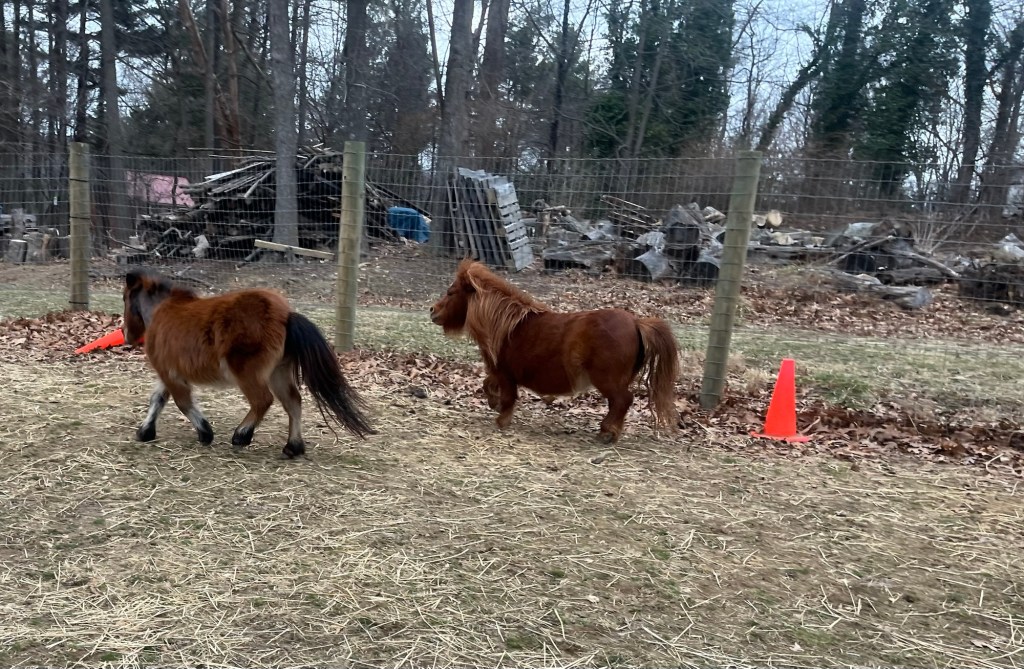
Image description: Two miniature horses, one chestnut and one bay, trot together in a paddock. The bay is tall, slender, and has proportions that strongly resemble that of a horse. The chestnut is short and squat, with a round forehead, potbelly, and proportionally short legs.
With all of that said, the majority of miniature horses fall in the $1000-$5000 price range. Trying to go cheap in the beginning is often more expensive because you end up with a horse with behavioral or health problems. Buying a good quality horse from a good program increases the likelihood that they will work out as a service animal, as that is, of course, never a guarantee.
Training a service animal is a years long process and involves hundreds of hours of work. The average cost of a service dog is between $20,000 and $40,000.
Obviously, most people don’t just have that laying around. That is why our program wants to be able to match people with fully trained horses at no cost. Currently, our horses cost $25,000 to train, but we are going to need to re-figure that estimate with the purchase of a new, significantly larger and nicer property to be our headquarters.
Companionship
Horses are herd animals, and we strongly advise that your service horse should have a companion. Ideally, this should be another miniature horse. A miniature donkey, sheep, or goat can work well, but because of the difference in communication and behaviors between the species, the relationship often isn’t very strong.
It is the rare horse that is able to do okay on their own without the companionship of other horses. Studies have found that even isolated horses who appear to be doing okay often have raised cortisol levels, indicating stress.
If your plan is to have just the one horse, it is important to understand that you will need to be way more hands-on with their management to keep them happy and comfortable. There is also a chance that the horse will not be able to handle the isolation, and may not work out as a service animal because of it.
Lifespan
The longer lifespan of a horse is one of the more common reasons people choose them for a service animal over a dog. While in many ways it’s very beneficial, it’s still important to think through the implications.
The average lifespan of a horse is 25 to 30 years. However, much like dogs, the smallest ones tend to live longer than the largest ones. Miniature Horses very regularly live to be 30 years old and older. Reaching their 40’s is not unheard of and happens more often than it does with full-size horses.
The increased emotional and financial toll of training multiple service dogs in the same span of time that a horse can work is a huge bonus for picking a horse for many people, but it is important to consider that you very well might have this horse a quarter of a century from now.
So, Is a Service Horse the Right Choice?
I know there are many more difficult and negative things presented in this article, but it is not meant to dissuade anyone. It is important to consider all of these practicalities before making such a big decision. There are many people for whom having a service horse is absolutely the right choice. After all, that’s why we’re here.
Owning and caring for your own horse is truly a lifestyle, but in a sense, so is being disabled. Having to be cognizant, deliberate, and make plans is pretty normal for so many of us with disabilities, and a service animal often becomes a part of that.
If you still like the idea of a service horse, but the amount of information presented here is overwhelming, just take a deep breath. There’s no reason to be in a hurry. Learn everything you need to about caring for a horse, and only take that big step once you are sure you are ready.
If you are ready to take that next step, we would love to help you on your journey. Please take a look at the requirements for students page to learn more about the application process and what we will need from you.
Whether or not you are considering working with us to get a service horse, we hope that you found this article helpful.
 Cheval Assistants and Leaders for Independence