Often, both in person and online, we come across the same myths and misconceptions about miniature service horses. Sometimes, people have genuine questions. Other times, people have already made up their minds, proclaim something, and don’t want to listen to us when we try to explain why it’s not true. Hopefully, if we continue to share information about service horses, less of the latter will happen. Here are some of the most common myths and misconceptions that we come across, and explanations for why they are not true.
Only dogs can be service animals.
In the United States, it is federal law that dogs and miniature horses are allowed to be service animals. States are allowed to expand the number of species with legal protections, and a few do, but are not allowed to restrict it. Service horses have full public access rights, same as service dogs.
Horses can’t be house trained.
How do you know, have you ever tried?
Racehorses are trained to urinate when they hear a whistle. Some horse owners like to teach their horses to avoid using certain areas, intentionally use others, or to potty at certain times, such as before getting into a trailer or going into a show arena. The process is very much like that of house training a dog, And can absolutely be done.
Horses have to have hay in front of them 24/7.
I have to say, I find it interesting that we get this on a regular basis, but I have never seen this criticism of any other type of working horse.
Horses do not need hay in front of them 24/7. What they need is unrestricted access to hay for the majority of the time. In a natural setting, horses spend about 16 hours a day grazing. Not only does that leave plenty of time for outings, But we utilize food rewards in our training, so the horses receive hay pellets while working. If going out for a longer period of time, handlers just need to plan ahead and bring some hay with them in order to give their horse a snack break part way through the outing.
Handlers have to tell you what task the horse does.
Handlers have to tell business owners who ask what tasks the animal is trained to perform, not members of the general public. They are also not required to disclose any medical information.
I think the majority of people can probably understand that it is quite rude and invasive to walk up to a complete stranger and ask them why they are using a walker or an oxygen tank. The same applies to service animal handlers.
Service animals don’t get time off.
They absolutely do. The majority of service animals work for far less time than they don’t. During that downtime, they are allowed to just be a pet.
Service animals have to wear a vest.
It has become incredibly common for people to do this, as accessories designating a service animal as such can really help to cut down on inappropriate interactions from the public. However, the law specifically states they are not required.
I saw a service animal sniff/look around/not be in heel position, it must be a fake.
Fake service animals have definitely become a problem, but spotting one is not that simple for several reasons.
First, it’s right in the name — animals. They aren’t robots. Everybody can get distracted, make mistakes, or have an off day. The key difference here between a real and fake service animal is the degree of distractibility, and how the handler manages it. A legitimate service animal handler will gently redirect a misbehaving or distracted animal. They may quickly do some repetitions of an easy behavior to get the animals brain into work mode. If the animal is truly having an off day and can’t be convinced to work, a service animal handler knows when to call it quits, even if that means not getting to stay out as long as they would’ve liked.
Second, although service horse/dog in training and service horse/dog are two different categorizations that denote the level of training that the animal has, training truly never ends. You don’t teach a fifth grader how to structure a sentence, and then completely stop teaching them how to write. If an animal isn’t 100% on their game, they may just be performing a behavior that they have not done in a long time, and they’re a little rusty. They may just need a quick reminder, and they’ll be good again. Or they may simply be learning a completely new behavior. Cali has been a working guide horse for 17 years, and has only just been learning how to pull a wheelchair. She did amazing, but wasn’t perfect the first few times. That doesn’t mean that she isn’t a bona fide service horse.

Third, the jobs that service animals do for people do not all look the same. Keeping an eye on the environment around them and smelling for potential triggers are completely valid tasks for multiple types of service work. The animal does not necessarily need to be in a heel position to perform tasks and, for some types of work, can’t be.
Miniature horses are too big to be practical, you can’t fit them into stores.
Usually received under a photo of one of our horses fitting in a store just fine.
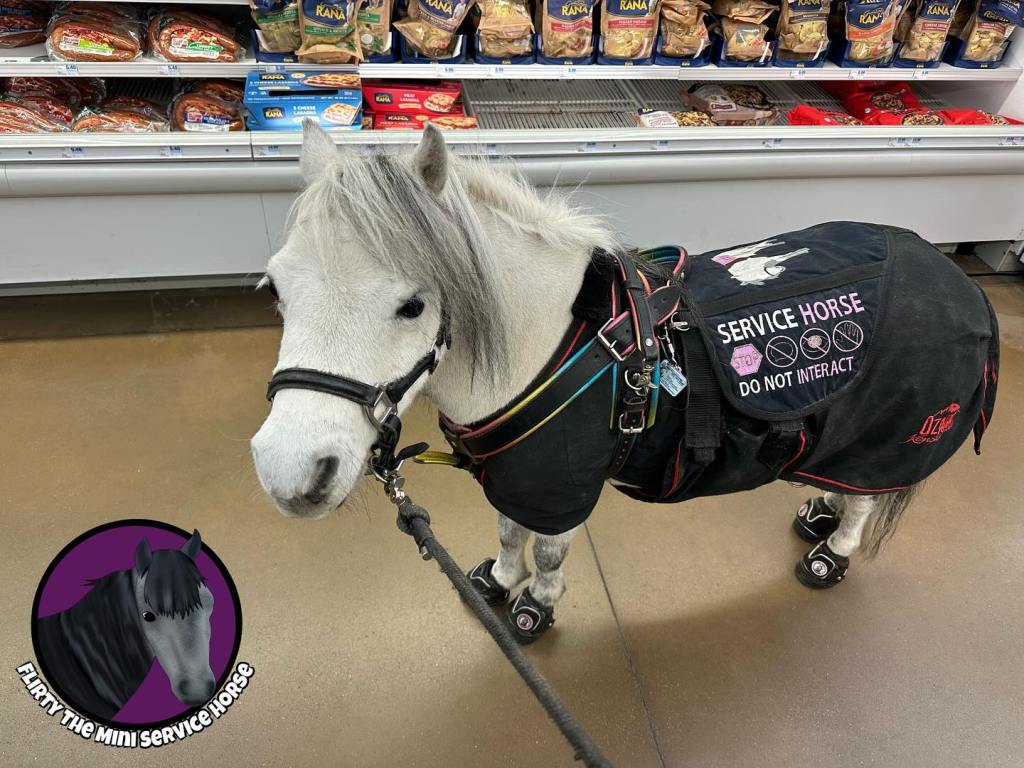
These little guys can fit into the vast majority of places without issues. They are equal in size, or somewhat smaller than, extra large dogs. They take up roughly as much space as a manual wheelchair.
Miniature horses are way smaller, those are ponies.
Typically, people marvel at how small our horses are. Sometimes though, people insist they can be much tinier. Our only guess as to why people might think that is that they’ve seen pictures of miniature foals, and thought that they were adults.
The goal of CALI Corp is to have as many horses that stand 28 inches or under as possible. Finding them that small without health conditions is not easy. When you take into account the color, temperament, and age requirements of our service horses, that drops the number of eligible horses by quite a bit. Plus, they are very desirable and tend to be extremely expensive.
As it is, all of our horses stand well under the recommended upper height limit for service horses of 34 inches. Most of them are 30 inches or shorter, and around 200 pounds. When you consider that the majority of riding horses stand between 58 and 66 inches and weigh between 1000 and 1200 pounds. I think that it is fair to say that our horses are quite small.
The pony part is true. Miniature horses are one of the smallest breeds of pony in the world.
Miniature horses live 45 to 50 years.
Miniature horses are quite long lived without needing to exaggerate. The average lifespan of a horse is between 25 and 30 years, but much like small dogs, miniature horses are more likely to exceed this average than big ones.
Service horses cost far more to care for than service dogs.
When comparing expenses with handlers who have extra large breed service dogs, we have found the cost of a miniature horse to be the same, and often lower.
That’s just a well trained horse, it’s not actually providing any assistance.
Thank you for the compliment about training. Just because you can’t tell what service the horse is providing, doesn’t mean that they aren’t doing it. You may simply not know what you’re looking for (plenty of service animal handlers will be able to tell you that people they encounter in public think that they are training the dog or horse for someone else), or the service that the horse provides may be intermittent, and they are currently waiting and watching.
Did you believe any of these things? We hope that, if you did, you have a bit more understanding now, and can see why they are not.
Even if you didn’t think some of these things were true, we hope you found this article helpful.
Either way, thank you for taking the time to read this article. Please consider sharing it, so others can learn as well. The more people that know about and understand service horses, the easier things are for people who use them. If you have further questions, Please feel free to ask them below or explore our other posts, as we are continually sharing information about service horses to help bring awareness and educate.
 Cheval Assistants and Leaders for Independence
Leave a comment