Question: What kind of gear do service horses wear? Do they wear a harnesss, like a Guide Dog, or do they lead from the head, with a halter or bridle?
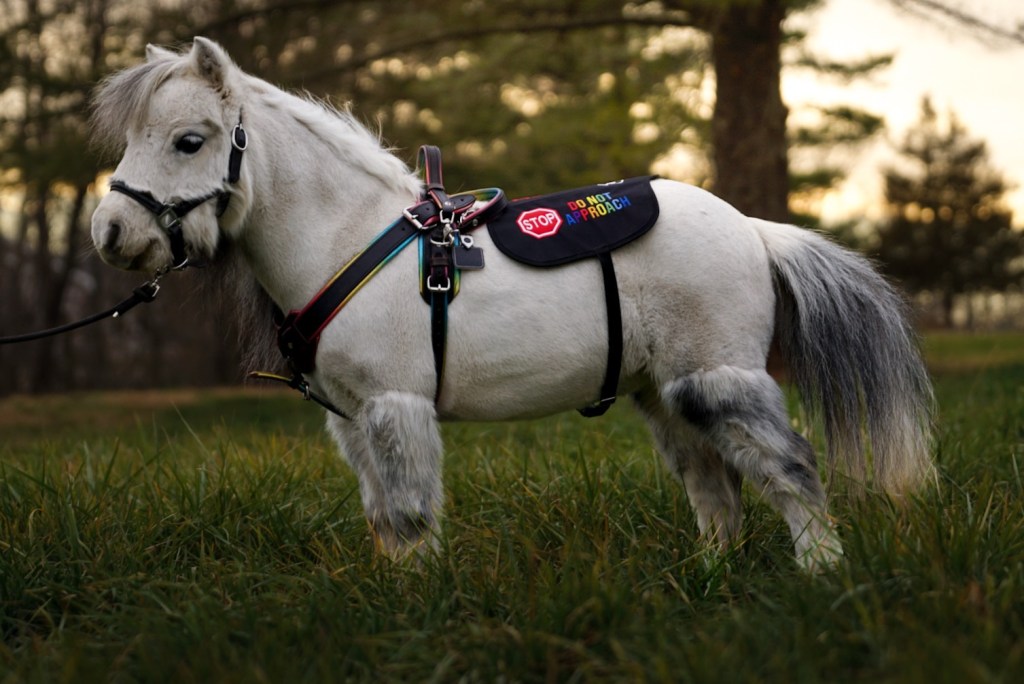
Answer: This will depend on each handlers’ preferences, and what the horse is trained to help them with. One common misconception is that a service animal must wear some sort of signage designating them as such. A handler may choose to do so, but this is not required. If the horse doesn’t need to wear any sort of special gear, it’s pretty common for them to have a cape. This is a signal to the horse that they are working, so they know exactly what to do, and it theoretically helps to cut down on members of the public distracting a working service animal.
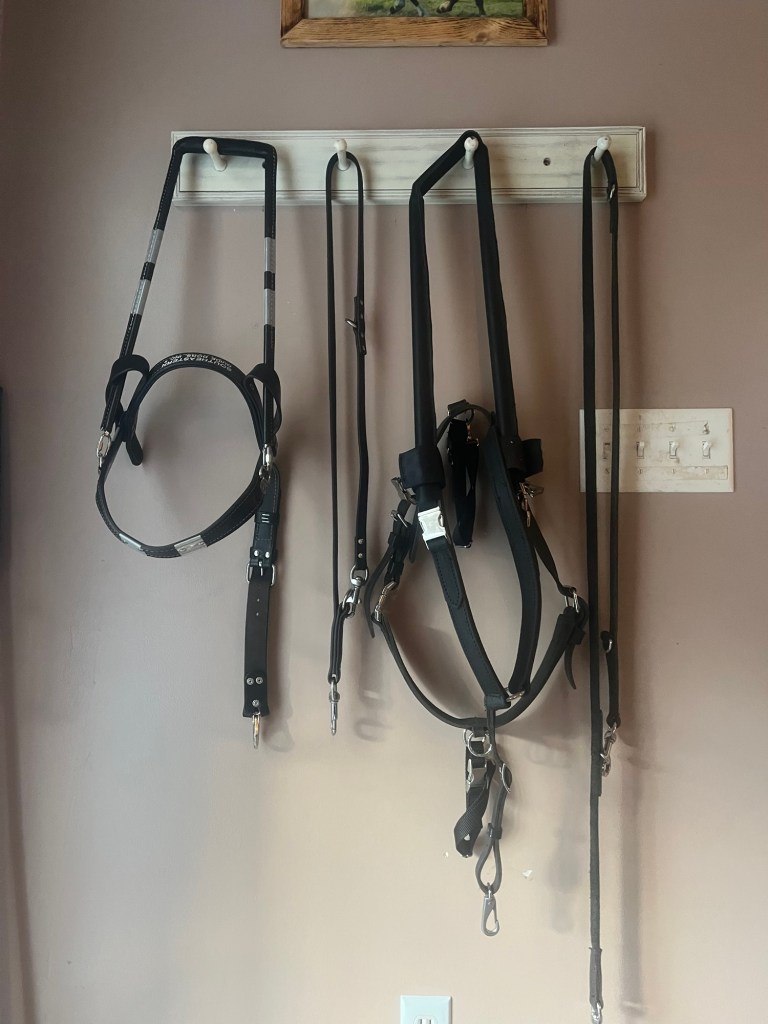
Our guide horse harnesses are not too dissimilar from what you would see on a guide dog. The front is shaped like the letter Y, with one piece that runs between the horse’s front legs and connects to the girth and two pieces that run up with the shape of the horses shoulder, connecting to the back of the harness. The body of the harness is just one circle that goes around the horses’ middle and buckles in place. There is a long, horizontal handle for a person to grab while the horse is guiding them and a smaller, upright handle that can be used for stability. Both handles are removable, so they can be exchanged for different sizes and shapes, disassembled to make the harness smaller for storage, etc.
Our harnesses have attachments for a relieving harness, which holds a bag for the horse to relieve into. There are also several extra D rings, so other things can be added. Each harness is handcrafted from leather, and because of different sizes and body types, a specific one will be made for each horse. These bags are not used in place of potty training. Rather, the handler attaches a bag to it when the horse needs to relieve themselves, and the horse eliminates into the bag. This allows the blind handler to simply tie and throw the bag away, rather than having to search for the pieces of manure on the ground. This can also be a benefit for people with trouble bending over or picking up smaller items like small pieces of manure.
As time goes on, we would like to play with different designs and make tweaks to existing ones to find the most optimal harness possible. For a horse doing heavy mobility work, the harness will need to distribute weight as much as possible, fit the shape of that individual horse, and not impede their movement. We will likely have a basic type of mobility harness we will use for training, and make a custom one for each horse and handler pair. We want to make sure the height and placement of everything is optimized for each person.
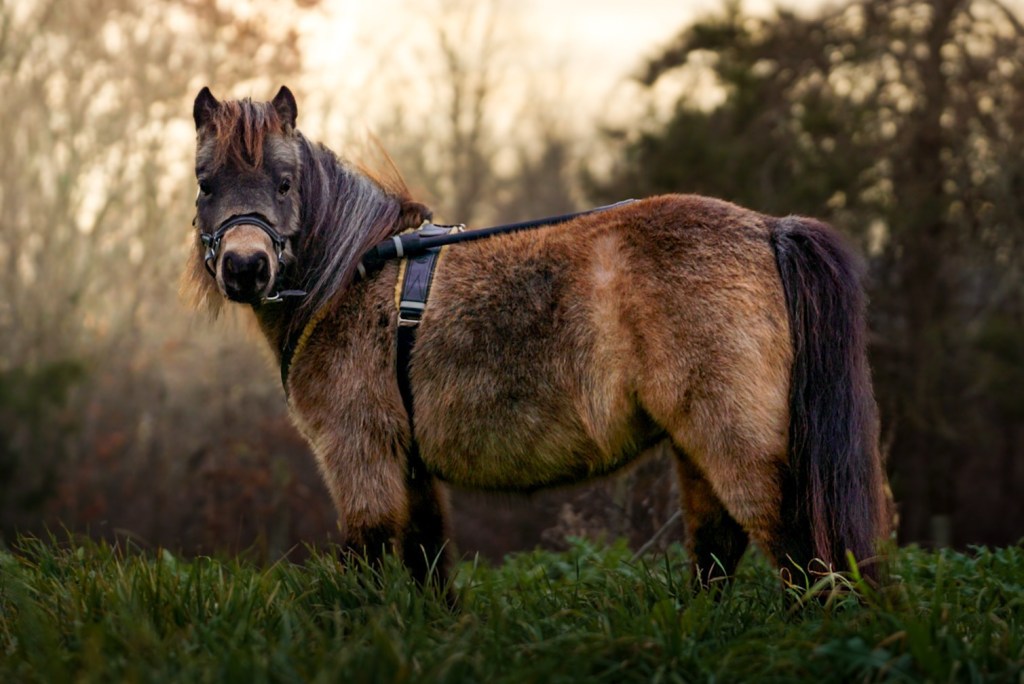
Here is an example of a mobility harness that is used by Abrea, one of our trainers. It is similar to the guide harnesses, in that it has a Y shaped front and then a saddle that goes behind the withers and a girth that goes under the legs and connects to the saddle. There is an upright, semi rigid handle that can be used for counterbalance, as well as a flexible pull strap that lays against Flirty’s back and can be used for forward momentum tasks or wheelchair pulling.
Horses work in just a regular halter. The lead we use with them is much like that which is used with a guide dog. It is a flat leather lead with a few D rings along its length and a snap at the far end. This allows you to lengthen and shorten it as needed. When a horse is working, the lead is typically kept at a medium length and draped over the harness handle, held in place between the fingers. It is largely there just in case, and is not how the horse guides or supports the handler.
Whether or not the horse wears shoes will again depend on the situation. Our horses learn to balance on slippery footing, such as tile, so they aren’t reliant on shoes. Our guide horses only get nonslip shoes when it is icy, and do just fine. For a horse doing mobility work, some kind of nonslip shoe for when they are working indoors on hard surfaces is ideal.
 Cheval Assistants and Leaders for Independence
Leave a comment