Whether you’re training it yourself or getting one from a program, deciding to get a service Animal is a huge decision, and there is a lot to consider.
What are the factors that might lead someone to choose a horse over a dog?
Cost
The upfront cost of training a service animal is extremely high. On the low end, you’re looking at about $10,000. For programs with a large staff, top quality facilities, and state of the art best practices in breeding and veterinary care, that price tag can easily reach $60,000.

The upfront cost and ongoing maintenance of a service dog and service horse are similar. However, a service horse will be able to work, on average, three times longer than a dog. The average working lifespan of a service dog is eight years. It is not at all uncommon for a miniature horse to be able to work for 24 years or more.
Lifespan
For someone who gets their first service dog when they are young and always wants to have one, the number of dogs you end up having over your lifetime really adds up. For many people, this takes an emotional toll. Not having to replace a working animal as frequently and the longer overall lifespan of a horse is appealing to many people.
Food motivated
Horses, being grazing animals, are inherently food motivated, and extremely trainable as a result. They will happily work for just forage pellets, which, being part of their diet, makes managing their weight, even while training with food, easily doable. Since they have evolved to trickle feed, eating small amounts of food spread out over a period of time is completely natural for them.
Obviously, dogs can be plenty food motivated as well. Sometimes this can be a bit more complicated for them, however. They eat much smaller amounts than horses, so they may become full, or some Dogs find play or interaction with people more reinforcing. This isn’t a bad thing, But does mean that there is a bit more for the trainer/handler to consider when working with the animal, and can be much more challenging for amateur trainers/handlers.
With horses, a lack of food motivation is almost never an issue, and in fact the opposite can be a huge problem. One of the many reasons we want to raise our service horses from foals is to make sure that they don’t develop anxiety around food, which is incredibly common with domestic horses.

Recognition that they are a working service animal
One of the biggest drawbacks to having a service horse is the amount of attention that you will get from people. They are still an unusual site, and most people haven’t seen one. Access refusals are still a big problem, and something you will have to be prepared to deal with. However, the other side of that coin is that many people recognize that the horse is a working service animal. Although many people nowadays are aware of, and better at respecting, service dogs, you will still encounter a lot of people interacting with and distracting them. Although you will have to answer many more questions about your service horse, you tend to get far fewer people crouching down to get in their face or making kissing noises at them like with dogs.
Allergies, phobias, and religion
If you, or a very close family member such as a spouse, have a severe allergy to dogs or phobia of dogs, they aren’t going to work as a service animal. In the United States, miniature horses are the only other legally protected type of service Animal. Although you can of course train any of your pets to help you around the house, the only animals that are legally allowed in non-pet friendly places are service dogs and service horses, making them the only alternative to a dog.
Excellent sensory perception
Horses’ senses are very highly developed. Because they are a prey species and dogs are predators, it’s a bit like comparing apples to oranges. Overall, however, their vision is better than a dogs. With eyes on the sides of their head, their visual field is 340°. Compare that to that of humans, which is 120°. Other than a triangle in front of their nose and a strip as wide as their head extending out straight behind their butt, horses can see everything around them at once.
Horses have excellent night vision. While it takes a long time for their eyes to adjust, (about 40 minutes, twice as long as it takes for humans) once they do, they can see well enough to navigate perfectly fine in situations where people are unable to see anything.
The visual acuity, which refers to the sharpness with which an object is seen, of a horse is about 20/33, while that of a dog is about 20/75. Most people are familiar with the average visual acuity of humans of 20/20. What this means is that, if you have a horse, dog, and human with average vision, an object that a horse is able to see clearly from 20 feet away can be seen from 33 feet by a person, and that an object a dog is able to see clearly from 20 feet away can be seen by a person from 75 feet away.
Horses are hardwired to notice even the smallest changes in their environment. Clever Hans was an excellent example of this.
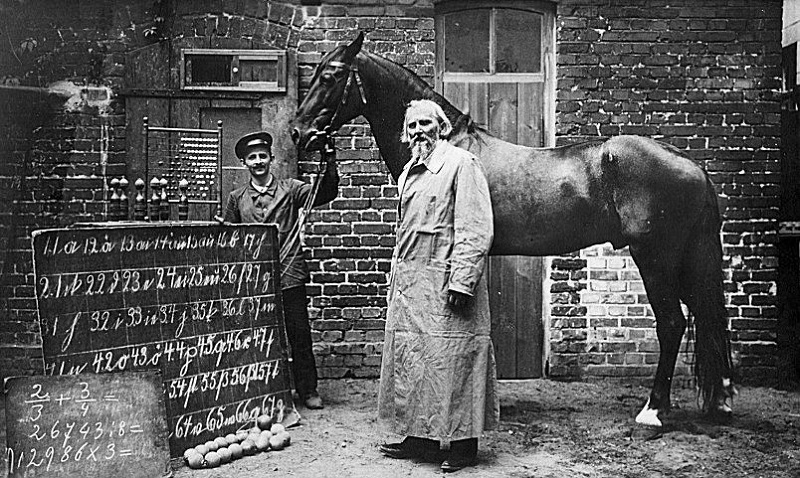
Clever Hans was an Orlov Trotter who became very well known for doing exhibitions around Germany in the early 1900s. His owner, a school teacher, trained the horse to an incredible degree, to the point where it seemed the horse was able to do complicated math problems, answer trivia questions, and distinguish between any number of shapes, colors, and other descriptive terms. Scientists began to study him to figure out how this would be possible. Even with these people that the horse didn’t know asking the questions and giving him no feedback, the horse still correctly answered complicated questions. It wasn’t until someone asked Hahns a question that he himself didn’t know the answer to that they figured out what was going on.
When Hans would select the right object or reach the right number when counting, the person would make an involuntary micro expression. It was so subtle that the scientists, who thought they were being completely impassive, didn’t even realize they were doing it. Hans noticed that micro expression, and knew that it was his cue to stop counting.
Because of their wide field of vision, excellent visual acuity, and observant nature, there are many handlers who feel more comfortable relying on a horse as opposed to a dog.
In many other ways, the sensory perceptions of horses and dogs are fairly comparable. For instance, they both have dichromatic vision. This means that, while they can see color, they can’t see as many as humans. Their color vision would be comparable to that of a person who is red green colorblind.
Horses also have an excellent sense of smell. It is almost as good as that of Dogs, and is a new area that people are only beginning to explore. There are already people who have trained horses for sent detection and tracking and using them in search and rescue. This is still extremely new territory for service horses, but, if someone desires an animal able to perform sent based tasks, they wouldn’t necessarily have to choose a dog over a horse to be able to do it.
Strength
Horses are incredibly strong, sturdy animals. They can carry and pull far more weight than dogs are able to without harmful effects on their bodies. The spine of a dog is very flexible, while that of a horse is not. While this does create one drawback for service horse handlers because their horses are unable to Bend themselves to curl up into small spaces the way a dog can, it does enable them to do work that would be harmful to a dog’s spine, or simply not within the realm of possibility.
If you have a pony that is well conditioned and fit, pulling a cart under ideal circumstances (meaning hard packed ground, and no big hills) they can easily pull three times their weight for a long period of time.
Even the tiniest horses are very strong, with the strongest breed of horse in the world compared to body size actually being the British Shetland. The smallest, daintiest horse is still going to weigh more than many of the most heavily built large breeds of dog. For instance, take Flirty, pictured above with the Old English Sheepdog. She stands a mere 27 inches tall and has a very slim, dainty build. She weighs in at just 140 pounds. According to the AKC, female Saint Bernards typically stand between 26 and 28 inches tall and way between 120 and 140 pounds. Just a tiny bit of height can make a huge difference. Ruby is just 1 inch taller than Flirty, but is built like a tank. We haven’t been able to get her on a scale so we don’t know her precise weight, but we do know that she’s closer to 200 pounds.
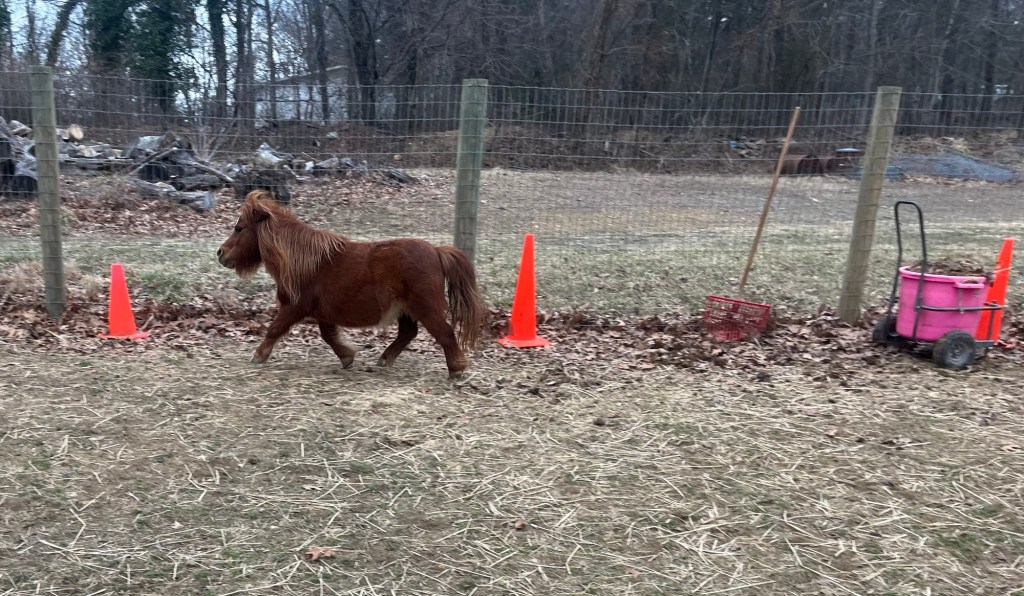
For someone with mobility problems, they can simply harness up the pony to a cart and take them for a drive, enabling them to get out and about without pain or fatigue. Helping to pull a handler who is in a wheelchair or moving heavy objects can easily be a normal part of a service horses routine.
You are also able to lean your weight on a horse in ways that you can’t with dogs. This could be as simple as a blind person being able to put a hand on their horses back if they lose their balance, to training a horse to do full-blown mobility assistance, such as helping a person to stand from a seated position, lean their weight on them as they walk or navigate steps, or help catch a person who is prone to losing their balance. While dogs can help with these things, they can’t do it even remotely as frequently as horses can, you can’t put nearly as much weight on their backs, and you always have to be extremely careful about where you place weight on a dog. Dogs are better suited for lighter mobility work, where just having the handle of a harness to pull against or provide proprioceptive feedback for balance is enough. For larger people or people who want to be able to truly lean their weight on their service Animal, a horse is a much better choice.
Excellent memory
The study of equine cognition is an extremely new area of research that has only begun in recent years. There is so much that we don’t know, but horses are certainly proving themselves to be more intelligent than some people give them credit for. There are still those who insist that horses are unintelligent animals only capable of responding to stimuli in their environment.
While it is true that the prefrontal cortex, the part of the brain responsible for higher thinking, is small in horses, that doesn’t mean that they are completely incapable of reasoning. They can’t make plans far out into the future or do extremely complicated reasoning tasks, such as pretending to be injured to get out of work, but they are absolutely able to problem solve and have an excellent memory.
Studies have shown that horses are able to distinguish and remember the faces of different people, read people’s facial expressions, distinguish different symbols, learn to express their desire (in the case of this study to have a blanket put on, removed, or not changed) to a human, have been shown to recognize that a human did not notice a carrot being placed nearby and try to urge the human to notice the carrot, and even understand a certain degree of object permanence. Horses are even among a small number of animals able to recognize themselves in mirrors, demonstrating a high amount of self-awareness.
There is so much more that needs to be studied, and intelligence is a very difficult thing to quantify, even in humans. For example, dogs do not pass the mirror test. However, dogs rely on their senses of smell and hearing more than eyesight. When given a cent based version of the test, they pass. In human children, culture has a very strong influence on the age at which children begin to pass the test. Horses, being very visual animals with no aversion to making direct eye contact with one another, are naturally far more likely to pass the test for those reasons alone.
While we can’t definitively say exactly how intelligent horses are or directly compare them to Dogs, it is evident that they are absolutely very intelligent animals. Service horses prove this over and over again. For example, on several occasions, Mona forgot her purse on the bus seat when she went to leave. Cali was never trained to do this, but she would stop, turn, and show Mona the purse instead of exiting the bus. Once Mona did grab her purse, Cali would head out like normal.
Another very cool example is from when Mona and I did a service horse demonstration at a Miniature Horse show in June 2024. As I stood in the center of the arena talking, Cali and Mona navigated around the arena, Cali diligently making sure Mona didn’t run into any of the obstacles that had been placed around the area. This was only the second time I had seen Cali in person, and the first time was when she was extremely sick and we only saw her for very brief periods. Cali has certainly heard my name plenty of times, but Mona never taught Cali which of the six new humans hanging around her that day was Teagan. Maybe she was able to make that connection, or maybe she just figured the thing she didn’t recognize the word for was the new human, but when Mona told Cali to “Find Teagan,“ She marched right over to the center of the arena, bringing Mona right to me.
While we can’t say that horses are unequivocally more intelligent than dogs, it is also obvious that they are not unintelligent animals incapable of problem-solving. The two species are probably relatively comparable on this point, but that is at least not a mark against horses when deciding which one would be the right service animal for you.
More independent
When choosing a service animal candidate, it’s important to find one who has a good balance between independence and affection for people. If you get one who’s too aloof, they aren’t as interested in doing stuff with and for people. If you get one who is too clingy, you have problems with separation anxiety.
Horses have not been domesticated for nearly as long as dogs (approximately 5000 years and 20,000 years, respectively) (and have been bred for different purposes. While some horses may be extremely people oriented, it will not be in the same way or to the same extent as Dogs. Depending on the environmental set up, personality, and health considerations of the person looking to get a service animal, this independence could potentially be a benefit.
For example, someone who struggles with fatigue may find the high energy levels of a young Labrador exhausting. The dog may enjoy going on an outing, but still has tons of energy and wants to play when you return. Because horses are grazing animals who spend so much time eating, a horse will likely be happy to go out in the yard, roll, and then eat for a few hours while the person takes a nap and recuperates.
Whether or not this ends up being a benefit depends largely on a person‘s set up. They may not have to walk the horse twice a day, but the horse does poop a lot more, which means more cleaning up after them. Does the horse have an outdoor dry lot, or is the dry lot the house? Because if it’s inside, a curious horse will happily get into anything and everything they can, just like a puppy.
This is more of a trade-off than it is an advantage of horses over dogs, but is an important one to think about. What works best depends very much on the personality of the person, the personality of the animal, and the environment that they are in.
This also has its advantages when working in public. A lot of people don’t seem to understand that the rule is not to distract service animals, and think they just shouldn’t pet. They love to make kissing noises, make eye contact, stand in front of the animal with their hands on their knees and shower praise upon them, and similar. For many Dogs, this is an irresistible invite, and they become completely distracted from their work. While a horse may find things annoying or distracting, accidentally making eye contact with a person who is actively trying to get their attention and invite them over isn’t going to send a horse into a fit of happy wiggles, and make them want to go up and lick the person‘s face.
If you are in the process of making this decision for yourself, I would recommend laying out and really thinking through all of these considerations, as well as the day-to-day practicalities of having a service animal in your life, which we also have an article on.
 Cheval Assistants and Leaders for Independence
Leave a comment